
If you work in L&D it’s likely you’re researching AI learning tools to solve language training needs. You've probably got questions about the EU AI Act and how it affects approvals, so you don’t stall before you can even roll it out.
In our recent webinar ‘The EU AI Act for L&D: How to adopt AI learning tools with confidence’, Busuu’s Felix Schuchter (Director of Sales) asks Javi Fernandez (VP, Product & Engineering) to break it down in simple terms. Here’s what you and your procurement team need to know before choosing an AI language learning tool.
This is the view of Busuu, not legal advice. It reflects the position as of 9 October 2026 (date of the webinar). Please check your own classifications with your legal team.
The act sorts AI by risk
The EU AI Act is only a risk-based framework, not a blanket restriction on AI, and the act sorts AI into four tiers:
- Unacceptable risk - Banned outright. e.g. social scoring, manipulative techniques, emotion recognition in workplaces and education.
- High risk - Strict rules apply from 2 December 2027. e.g. recruitment, evaluating learning outcomes, and evaluating worker performance.
- Limited risk - Must tell people when they’re interacting with AI, unless it’s obvious, and mark AI-generated content. e.g. chatbots.
- Minimal risk - Few specific obligations. e.g. AI in video games.
Javi pointed out that the framework is clear on language and communication training. “AI in learning is not banned. Practising conversations, content generation, and feedback tools are not prohibited uses.” This clears the way for tools that let teams practise in a safe, stress-free environment while getting clear, objective feedback to build confidence.
He says to use caution with any tool that claims to read learners’ emotions. “That is banned, apart from certain medical and safety exceptions.” The key is to identify an acceptable level of risk and avoid blanket labels.
What the tool does matters more than whether it uses AI
“What I hear the most is if it uses AI, it’s heavily regulated. And that’s not how the act works,” Javi said. “The EU AI Act looks at what a tool is used for, not whether AI is inside or not.”
AI used to evaluate learning outcomes is considered high risk, including where those outcomes steer the learning process. The same goes for evaluating worker performance.
In practice, that splits most learning features into two groups:
- Features that score or assess a learner: these deserve a closer look.
- Features that generate practice without scoring anyone: these matter far less.
How your organisation uses the tool counts as much as how the vendor built it. Feeding practice scores into performance reviews, promotions, or role decisions can change the analysis, even where the tool was never intended for that, and in some cases it moves the obligation from the vendor to the organisation using the tool.
Key takeaway: Settle this in writing early, agree the intended use with your vendor, and stick to it. If a vendor tells you they’re exempt because their tool only performs preparatory tasks, question that claim.
It doesn't apply when the system profiles people and the vendor must document that assessment and register the system in the EU public database.
A vendor may also reassure you that a human makes the final call. Question that one too. “If the person simply approves whatever AI suggests, then AI is effectively deciding,” Javi said. It’s one factor among several, not a free pass.
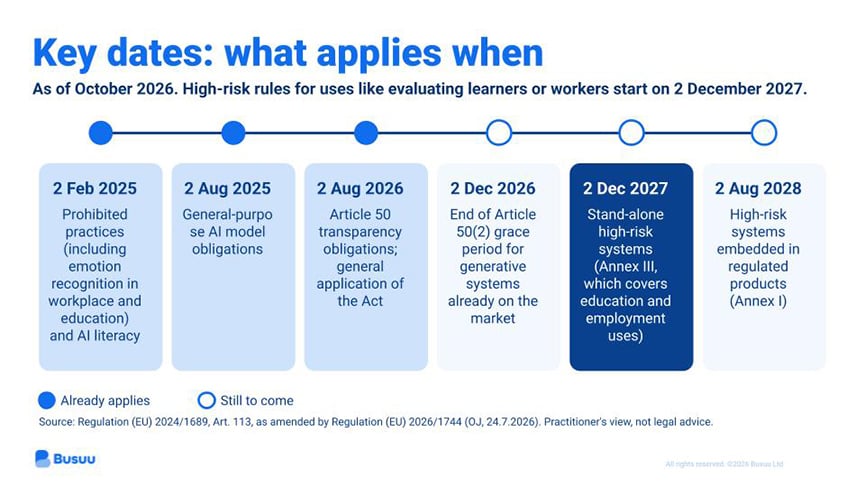
Don’t wait. Procurement teams are asking these questions now.
Who to involve, and what to ask for
Stalled evaluations often happen when the right people join the conversation too late.
Start with your core group:
- Legal or the data protection officer
- IT and security
- Procurement
- The people team or HR
“Each of these groups will ask different questions, and each of them can slow things down if they join in late,” Javi said.
Then add employee representatives, wherever the tool evaluates or monitors employees. Works councils are the classic example, and national labour law in Germany and Spain can require you to involve them early. If you operate there, don’t wait.
L&D belongs in the room too. The act’s AI literacy duty has applied since February 2025, and you’re the people best placed to deliver it.
Once everyone’s in, the questions pile up. Javi advised separating them, because they have different answers.
About the EU AI Act itself:
- What is the intended use of the tool?
- How does the vendor classify each feature that evaluates learners?
- What transparency and human oversight are in place?
- Can a learner tell they’re dealing with an AI?
- Can a person step in and review the outcome?
About data protection, security, and GDPR:
- Where is the data stored?
- Who can see it?
- Who are the sub-processors?
- Is there a data processing agreement in place?
Most of the friction in practice comes from the GDPR side. Procurement and IT have always asked these questions, and they hold up deals simply because the paperwork isn't readily available. The good news is they resolve quickly when a vendor already has the documents to hand. You can see Busuu’s compliance information here for reference.
You should always ask: what documentation exists to prove it? "Anyone can say the right things, but the vendors worth shortlisting are the ones that can show the paper trail," Javi said.
You can group the evidence requests into these separate asks:
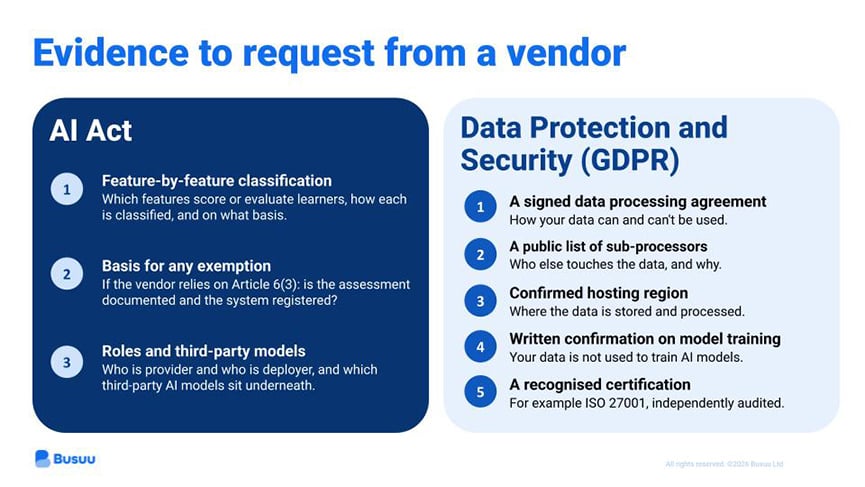
Ask for both sets. A perfect data processing agreement doesn’t answer the classification set.
“If a vendor can hand you this pack on request, you’ll usually be moving within days rather than months,” Javi said.
How can you show transparency in practice?
Transparency is critical, and it comes down to two things. People must be told when they're interacting with an AI system, and AI-generated content must be marked or labelled where the rules require it.
These transparency rules have applied since August 2026, so they're live now, and the in-product view should be simple. A learner opening a speaking practice tool should know, clearly and without digging, that they're talking to an AI and not a real person.
When reviewing tools, look for two things:
Clear disclosure inside the product itself.
The vendor's written explanation of how it handles transparency, including where learners are told, what content is labelled, and what is still being rolled out.
Keeping the layers apart matters here. "Transparency is the first layer, and it applies now," Javi said. The bigger requirements, risk management, documented human oversight, and technical documentation belong to the high-risk layer, which applies only to specific uses and later.
Felix’s demo stage tip: Ask the person showing you the product how they make sure learners know AI is being used, and look for that signposting while you're in the product rather than only in the paperwork.
Lead with the problem and keep human judgement in the loop
By leading with the problem, not the AI features, you steer approvers toward the outcomes, rather than the features on offer. If more of your employees need speaking practice than your current tools or provider can offer, AI is how you solve this gap, not the reason you’re asking.
Make your case clear with these three points:
- Bring the evidence with the pitch, not after someone asks for it.
- Frame it as risk management rather than risk-free. Nobody believes risk-free. Set out the risks, what you've asked the vendor to prove, how you'll use the tool, and who's keeping an eye on it.
- Be accurate about dates. Reviewers will check them, and the transparency rules, grace periods, and high-risk timeline have all moved before. A wrong date is a small mistake that makes people doubt everything else.
Keeping a person in charge of the decision is good design. The AI produces the practice and the feedback, and the learner or their manager decides what to act on. “AI prepares people to use their own judgement better. It does not replace it,” Javi said.
A score that affects someone’s career falls under stricter rules, even if a manager signs off on it. So when a vendor says a human is always in the loop, ask them to walk you through each feature and what happens to the results. That’s what your legal team will want to see.
Tip from Javi: “Human oversight is a good principle. Understanding what each feature does is what makes it credible.”
Top three takeaways
In summary, Javi landed on three key takeaways:
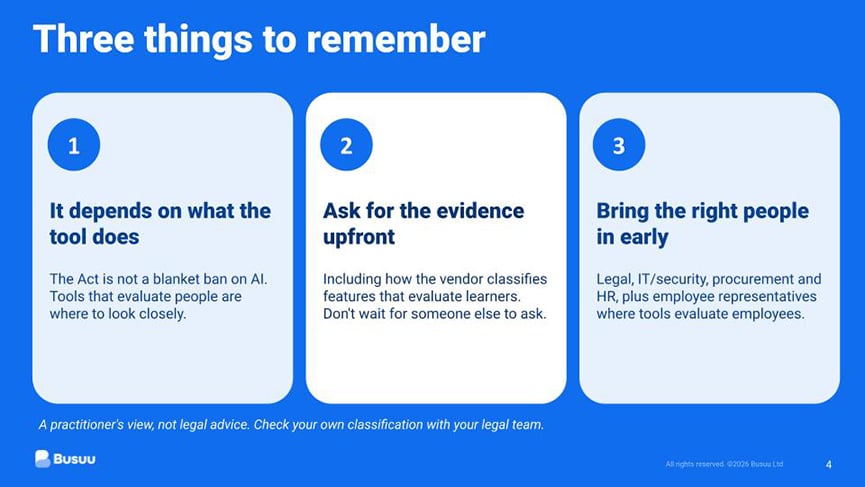
Watch the full webinar recording, or get in touch with Busuu for Business to see how we answer these questions. Explore Busuu for Business
Want to catch-up on the webinar? Watch the full recording here.