
The corporate world has a communication problem. And, as companies have started to expand globally, it’s only becoming more prominent. In fact, data by Harris Poll Research suggests that miscommunication in the workplace has caused as much as $1.2 trillion in losses every single year.
Communication breakdowns are felt all across a business, with 86% of executives citing poor collaboration and communication as key drivers for workplace failure. Simply put, the writing’s on the wall — communication needs to be a corporate priority in 2026 and beyond.
Corporate language training is one of the most effective ways of improving cross-team communication and driving collaboration. But it’s not just language skills on the line. An investment into language training leads to productivity and effectivity benefits, too.
Let’s dive in and see innovative approaches to corporate language training and driving better workplace collaboration.
Why corporate language training matters for global organisations
Effective communication is the backbone of every team. Even skilled teams will struggle to deliver if they can’t effectively communicate well. In fact, Grammarly estimates that miscommunication and ineffective communication cause as much as $1.2 trillion in annual losses. Considering 88% of the week is spent on communication, it’s not hard to imagine why.
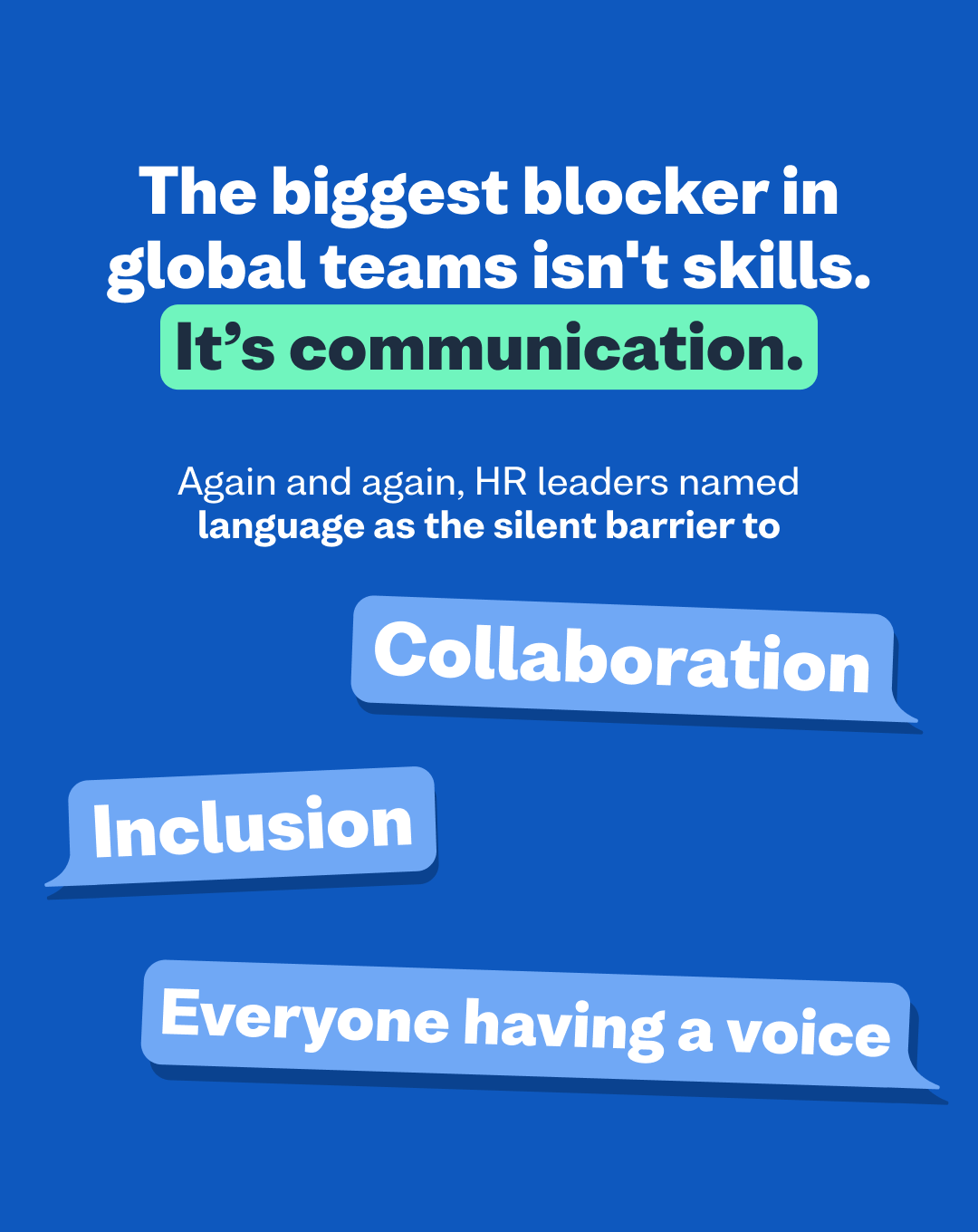
When you provide corporate language training to your employees, you invest in better communication for everyone. A structured programme can help by:
- Boosting productivity in cross-border teams: From facilitating cross-border team meetings to making project updates seamless, language abilities bring your organisation closer together and help with international collaboration.
- Enhancing project delivery speeds: Language-enabled workforces have fewer miscommunications, helping to move through work quicker.
- Improving employee retention: When you show you’re willing to invest in your employees, they’re more likely to recognise your company as a great place to work.
Removing language barriers and facilitating easier communication helps your teams work with clarity and confidence.
Setting objectives and measuring success
Delivering an impactful language training programme begins with setting clear business intentions. Understanding what you want to achieve with your programme will point you towards the best structures and learning methods.
Aligning your corporate language training with business goals can help connect the programme to organisational priorities. For example, your customer-facing teams might need improved conversational fluency, while leadership teams might benefit more from collaboration-focused workshops.
Connecting specific outcomes to your training will make sure that all your efforts directly support real-world performance.
Baseline assessment and progress tracking
An effective way of measuring success in your corporate learning training programmes is to conduct pre- and post-assessment tests to monitor improvement over time. You can use the CEFR language scale to measure progress over time, setting consistent tests that show how far your employees have come.
The CEFR system also gives your employees pre-defined levels to work towards, helping improve motivation and allowing them to better understand what they’re working towards.
Designing a future-proof language programme
The best corporate language programmes will evolve with your business; as the needs of your company change, it, too, will shift. Equally, technological advances or workforce changes will let you adapt how you run your language programme.
Part of creating the very best possible language training programme is to tailor the experience to your learners.
Analysis and audience segmentation
A strong programme revolves around your employees, understanding how best they learn content and delivering information at the level they’re at currently.
Analyse your cohort’s current language proficiency, their job roles and communication requirements, and their learning preferences. Another area to take into account is their time availability. Especially with larger groups, an asynchronous approach may bring the flexibility your workers need to fully participate.
Based on your analysis, you can segment your workforce into smaller groups. Doing so ensures your teaching remains targeted and relevant for the group, improving how effective it will be for them.
Custom vs. ready-made programmes
When implementing a learning programme, one of the first questions you’ll come across is whether to build your own or use a ready-made programme. Neither of these is inherently the better option, both presenting unique advantages.
- Custom programmes: Offer more flexibility and are targeted to specific roles or skills, which may accelerate time-to-usefulness within your classes. However, a custom system is more resource-intensive to implement.
- Ready-made programmes: Provide scalability and a faster implementation timeline, letting your teams hit the ground running faster. This approach is better for larger teams that may have diverse needs.
In many cases, you might take a blended approach, delivering structured courses alongside role-specific content to give your employees the best possible learning experience.
Delivery models, measurement, and engagement
Maximising the impact of corporate language training requires alignment between how you deliver learning, how you measure success, and how your employees experience the programme. When all of these pieces fit together, your training will become both highly scalable and closely coupled with business outcomes.
Let’s review the three central pillars that you’ll need for a high-impact, innovative corporate learning system.
Flexible, technology-enabled delivery
Learning training should support your employees without disrupting their day-to-day schedules. To enhance accessibility and improve engagement rates, offer your programme with the following aspects:
- Flow-of-work learning: Provide bite-sized lessons and microlearning opportunities that integrate into daily tasks, making it easier to build a consistent habit.
- LMS and mobile access: Integrating your training programme with a language management system will help to centralise training and tracking. Add in mobile access for employers to support them on the go and enhance accessibility.
- AI-supported coaching: AI-enabled learning can react to speech and provide feedback on grammar in real-time, offering immediate and personalised support for your employees.
By combining a technology-enabled approach with live lessons with a licensed professional, you support your employees’ learning from every angle.
Clear measurement and ROI tracking
Language training programmes need clear frameworks in place that you can use to measure progress and demonstrate value to senior leadership. Having direct ties between learning outcomes and business performance will ensure your programme stays on track while delivering tangible value.
Here are some central metrics you can use to demonstrate progress and prove ROI:
- Time-to-competency: Track how quickly employees reach the required language competency for their role, helping to understand how quickly your programme delivers results.
- Performance impact: Measure improvements in communication, task efficiency, and overall productivity within multi-lingual teams.
- Retention and engagement: Monitor employee turnover before and after implementing your training programmes. Investments in Learning and Development programmes have a direct impact on employee wellness and can boost workplace satisfaction, leading to higher retention.
- Customer outcomes: Evaluate how improved language skills lead to better customer experiences, especially in customer support channels with multi-lingual agents.
Consistently tracking these areas over time will help you refine your programme and continually adjust it to enhance its ROI.
Culture, inclusion, and engagement
An important aspect of language learning programmes that should not be overlooked is their ability to contribute to a more inclusive and engaged workplace. By supporting employees in developing language skills, you can help break down barriers between teams and foster a sense of belonging.
To maximise how effective your learning programme is for inclusion, consider these areas:
- Accessibility: Ensure your training is accessible to employees at all language levels, using the CEFR scale to support people through every stage of learning.
- Multi-lingual inclusion: Providing content in multiple languages, where possible, lets employees from across the globe engage fully in your learning programmes.
- Psychological safety: Your learning environment should be supportive, with every employee feeling able to contribute ideas and ask questions.
Embedding language learning into your company culture helps foster cross-cultural collaboration while also building stronger communication pathways. It’s a company-wide initiative that can snowball into gains in employee wellness, productivity, and overall company success.
Make learning a central part of your company culture with Busuu
An investment into corporate language training is one into productivity, efficiency, and collaboration in your work environment. By taking a combined approach to language training, you can find a delivery system that works best for your teams.
For industry-leading corporate language training, Busuu has you covered. Trusted by over 600 brands around the world, Busuu offers 14 internationally recognised complete language courses, fitted with specialist subject courses. Whether your learners are just getting started on their language journey or are already conversational experts, Busuu’s blended model that offers both self-paced study and teacher-led Live Lessons will help them build fluency faster.
Book a demo to find out how Busuu can help your workforce enhance its communication today.